Imagine you are in a candy shop. You see a single piece of sugar. It is small, shiny, and very sweet. This is called a monosaccharide. I
It is the simplest type of sugar, and it gives quick energy to your body.
Now, imagine a jar full of gummy bears, all joined together like a chain. This is called a polysaccharide, which is made from many simple sugars stuck together.
. Monosaccharides give fast energy, like a quick candy boost.
Polysaccharides give energy slowly, like food that keeps you going all day.
Pronunciation:
- Monosaccharide: US /ˌmɒn.əʊˈsæk.ə.raɪd/, UK /ˌməʊ.nəʊˈsæk.ə.raɪd/
- Polysaccharide: US /ˌpɒl.iˈsæk.ə.raɪd/, UK /ˌpɒl.iˈsæk.ə.raɪd/
Difference Between Monosaccharides and Polysaccharides
Structure
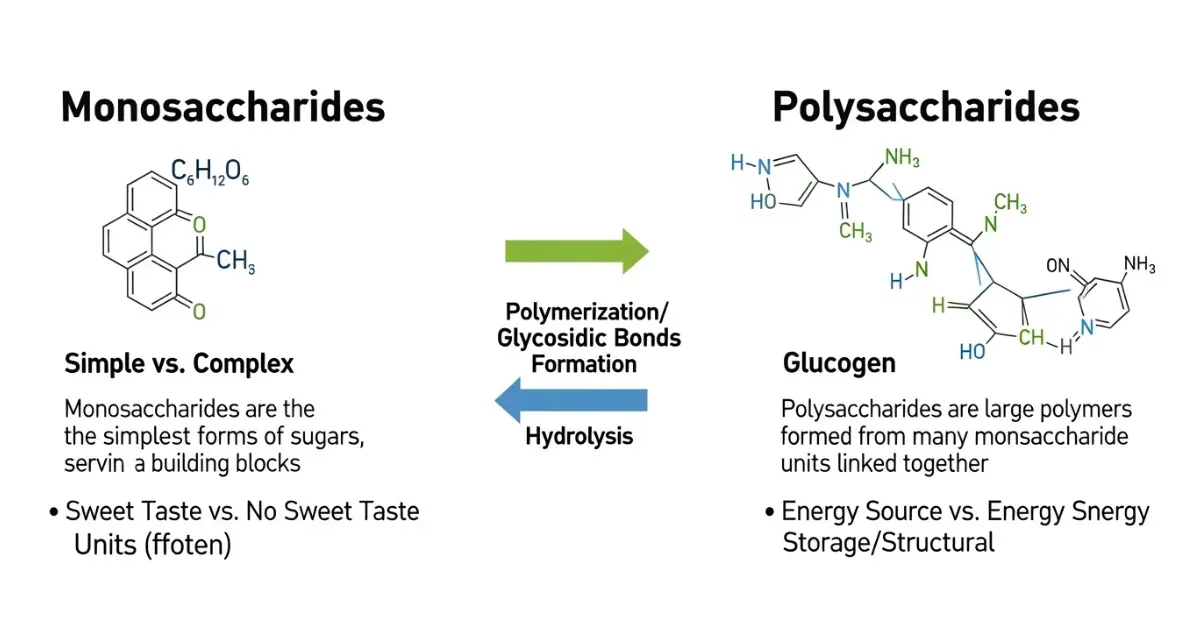
- Monosaccharides: One sugar unit. They are simple.
- Polysaccharides: Many sugar units joined together in a long chain.
Examples:
- Glucose (monosaccharide) is in grapes and apples.
- Starch (polysaccharide) is in potatoes and rice.
Taste
- Monosaccharides are sweet.
- Polysaccharides usually do not taste sweet.
Examples:
- Table sugar (monosaccharide) is sweet.
- Rice (polysaccharide) is not sweet.
Solubility
- Monosaccharides dissolve easily in water.
- Polysaccharides do not dissolve easily.
Examples:
- Glucose mixes in water quickly.
- Cellulose in plants does not mix with water.
Energy Release
- Monosaccharides give energy fast.
- Polysaccharides give energy slowly over time.
Examples:
- Eating candy (glucose) gives quick energy.
- Eating oatmeal (starch) gives energy for hours.
Size
- Monosaccharides are small.
- Polysaccharides are big molecules.
Examples:
- Glucose is tiny.
- Glycogen in animals is huge.
Digestion
- Monosaccharides go into the blood quickly.
- Polysaccharides need to be broken down first.
Examples:
- Fruit sugar enters the blood fast.
- Potato starch is digested slowly.
Function in Nature
- Monosaccharides give instant energy.
- Polysaccharides store energy and give structure.
Examples:
- Glucose fuels your brain quickly.
- Cellulose forms strong plant cell walls.
Chemical Formula
- Monosaccharides: simple formula like (CH₂O)ₙ.
- Polysaccharides: many monosaccharides joined together.
Examples:
- Glucose: C₆H₁₂O₆
- Starch: (C₆H₁₀O₅)ₙ
Occurrence
- Monosaccharides are in fruits, vegetables, and honey.
- Polysaccharides are in grains, potatoes, and plant fibers.
Examples:
- Honey has fructose.
- Wheat has starch.
Industrial Use
- Monosaccharides: sweeteners, fermentation, candy.
- Polysaccharides: thickening food, making paper, biodegradable stuff.
Examples:
- Glucose syrup in candy.
- Cellulose in paper.
Nature and Behavior
- Monosaccharides: Small, fast, soluble, quick energy.
- Polysaccharides: Big, slow, not soluble, long-term energy, structure.
Why People Are Confused
Both are sugars, so people mix them up. Starchy foods like rice seem like sugar because they are carbohydrates, but they are complex sugars that take longer to give energy.
Which is Better in What Situation
- Monosaccharides: Best for quick energy, like during sports or when you are tired.
- Polysaccharides: Best for long-lasting energy, like breakfast oatmeal, rice, or bread.
Metaphors and Similes
- Monosaccharides: “Sweet as honey” – fast happiness and energy.
- Polysaccharides: “Strong like a tree” – gives support and stability.
Connotative Meaning
- Monosaccharides: Positive (sweet, energy, happy)
- Polysaccharides: Neutral (strong, stable, healthy)
Idioms and Proverbs
- “Sugar and spice makes everything nice” – monosaccharides symbolize sweetness.
- “Strong as an oak tree” – polysaccharides symbolize support and strength.
Works in Literature
- Sugar by Bernice McFadden (Fiction, 2012) – talks about the sweetness of life.
- Wheat and Fiber by John Green (Non-fiction, 2018) – explains polysaccharides.
Movies
- Sugar Rush (2013, US) – fun movie about candy (monosaccharides).
- Starch Wars (2017, UK) – movie showing starch and polysaccharides in food.
Frequently Asked Questions
What is the main difference? Monosaccharides are single sugars; polysaccharides are chains of sugars.
Which gives faster energy? Monosaccharides give fast energy.
Are both found in nature? Yes, monosaccharides in fruits, polysaccharides in grains.
Do polysaccharides taste sweet? Usually no.
Why are they important in our diet? Monosaccharides for quick energy, polysaccharides for long-term energy and fiber.
How Both Help the Environment
- Monosaccharides: Give energy to humans, animals, and plants.
Final Words
Monosaccharides and polysaccharides are both very important. They are sugars, but they work differently in our bodies.
Conclusion:
Monosaccharides and polysaccharides are both carbohydrates, but they behave differently. Simple sugars like glucose give fast energy, while complex sugars like starch give energy slowly and help plants grow strong.
Monosaccharides and polysaccharides work together to keep us healthy and provide energy for life. By learning about them, even kids can make smart choices about food, energy, and health.

I am a professional English article writer with expertise in creating clear, well-researched, and engaging content. I specialize in writing informative articles that maintain accuracy, strong structure, and a polished tone. My work reflects a deep understanding of grammar, vocabulary, and audience needs. I am committed to delivering high-quality content that communicates ideas effectively and adds value to readers.