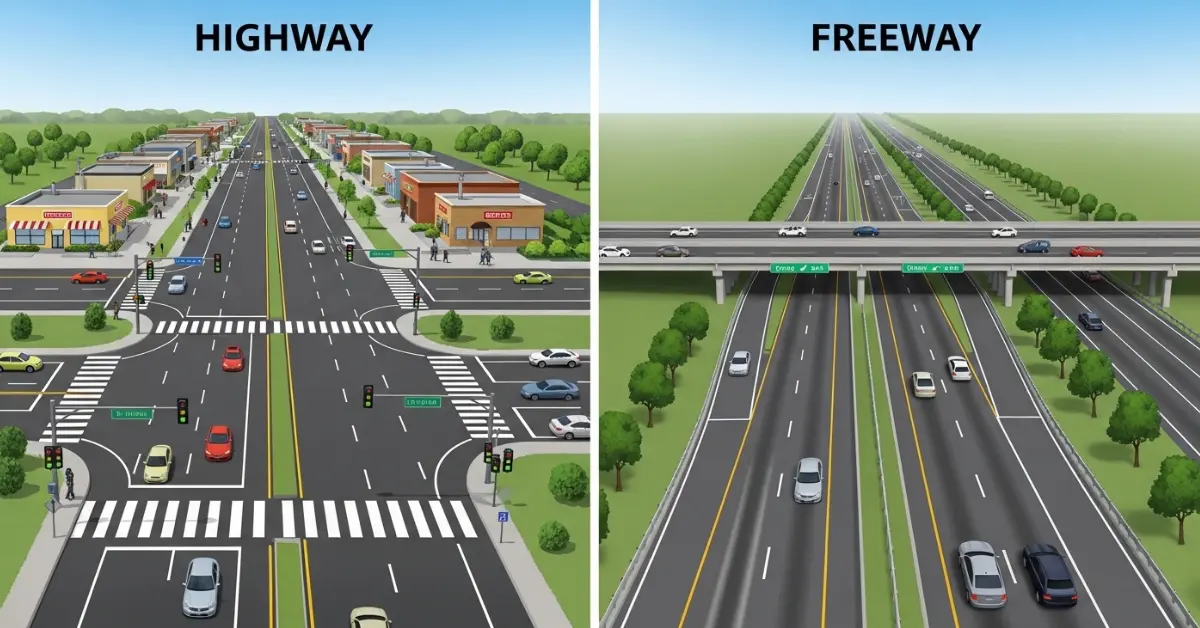
One day, Ali was traveling with his family. They first drove on a busy road full of signals, shops, and crossings. His father said, “This is a highway.” Later, they entered a smooth road with no signals, no stops, and cars moving very fast. His father smiled and said, “Now this is a freeway.”
This simple trip helps us understand the difference between highway and freeway. A highway is a main road that connects cities, but it can have traffic lights and intersections. A freeway is a special type of highway where cars move freely without stopping. Knowing the difference between highway and freeway makes travel easier and safer.
Key Difference Between Highway and Freeway
Difference between highway and freeway is that highway have crossings, while a freeway has no stops.
Why Is This Difference Important?
Understanding the difference between highway and freeway is important for learners and experts. Drivers can choose the best route and avoid delays. Students learn how road systems work. Engineers and planners design better roads for safety and speed. In society, these roads help in trade, travel, and daily life. Knowing their difference helps reduce accidents and saves time.
Pronunciation (US & UK)
- Highway
- US: /ˈhaɪ.weɪ/
- UK: /ˈhaɪ.weɪ/
- Freeway
- US: /ˈfriː.weɪ/
- UK: /ˈfriː.weɪ/
Difference Between Highway and Freeway
1. Traffic Control
Highway: Has signals and stop signs.
- Example 1: Cars stop at a red light.
- Example 2: Pedestrians cross the road.
Freeway: No signals or stops.
- Example 1: Cars move without stopping.
- Example 2: No pedestrian crossings.
2. Speed
Highway: Speed may change.
- Example 1: Slow near towns.
- Example 2: Fast in open areas.
Freeway: High and constant speed.
- Example 1: Cars move fast all the time.
- Example 2: No slowing for signals.
3. Access Points
Highway: Many entry and exit points.
- Example 1: Small streets join it.
- Example 2: Shops open directly onto it.
Freeway: Limited entry and exit points.
- Example 1: Entry through ramps.
- Example 2: Exit only at marked points.
4. Intersections
Highway: Has intersections.
- Example 1: Roads cross each other.
- Example 2: Vehicles turn at junctions.
Freeway: No intersections.
- Example 1: Roads pass over or under.
- Example 2: No direct crossing.
5. Pedestrian Access
Highway: Pedestrians may cross.
- Example 1: People walk across.
- Example 2: Shops attract walkers.
Freeway: No pedestrian access.
- Example 1: Only vehicles allowed.
- Example 2: Fences stop people.
6. Traffic Flow
Highway: Can be slow or busy.
- Example 1: Traffic jams in cities.
- Example 2: Stops at signals.
Freeway: Smooth and fast flow.
- Example 1: No stopping traffic.
- Example 2: Long-distance travel is easy.
7. Safety Level
Highway: Less safe due to crossings.
- Example 1: Risk at intersections.
- Example 2: Mixed traffic types.
Freeway: Safer due to controlled access.
- Example 1: No crossings.
- Example 2: Only fast vehicles.
8. Usage
Highway: Used for short and long travel.
- Example 1: City to nearby town.
- Example 2: Daily commuting.
Freeway: Mostly for long-distance travel.
- Example 1: Travel between big cities.
- Example 2: Long road trips.
9. Road Design
Highway: Simple design.
- Example 1: May have two lanes.
- Example 2: Can pass through towns.
Freeway: Advanced design.
- Example 1: Multiple lanes.
- Example 2: Separate directions.
10. Stops and Services
Highway: Shops and fuel stations nearby.
- Example 1: Small stores on road.
- Example 2: Easy to stop anytime.
Freeway: Services at special areas.
- Example 1: Rest stops.
- Example 2: Fuel stations at exits.
Nature and Behaviour
A highway is flexible and connects many places, including cities, towns, and villages. It allows mixed traffic and different speeds. A freeway is controlled and designed for speed and safety. It allows only fast vehicles and smooth movement without interruptions.
Why People Are Confused
People are confused because both roads are large and used for travel. In some countries, the word “highway” is used for all big roads, including freeways. This makes the difference between highway and freeway unclear.
Which Is Better in What Situation?
A highway is better when you need to travel within cities or visit places along the road. It is useful for short trips and daily use. You can stop easily and access nearby areas.
A freeway is better for long-distance travel. It saves time because there are no stops. It is ideal for fast and smooth journeys between cities.
Metaphors and Similes
- Highway: “Life is like a highway with many turns.”
- Freeway: “His work went smoothly like a freeway.”
Connotative Meaning
- Highway: Neutral (common and everyday road)
- Example: “The highway was busy today.”
- Freeway: Positive (fast and smooth)
- Example: “Her success was like a freeway, fast and clear.”
Idioms or Proverbs
- “Hit the highway” (leave or start a journey)
- Example: “We decided to hit the highway early.”
Works in Literature
- On the Road (Novel, Jack Kerouac, 1957)
- The Road (Novel, Cormac McCarthy, 2006)
Movies Related to Roads
- Highway (2014, India)
- The Road (2009, USA)
FAQs
1. Is a freeway a type of highway? Yes, a freeway is a special type of highway with no stops.
2. Why are freeways faster? Because they have no signals or crossings.
3. Can pedestrians use a freeway? No, only vehicles are allowed.
4. Are all highways slow? No, some highways can be fast too.
5. Which is safer? Freeways are usually safer due to controlled access.
How Both Are Useful for Surroundings
Highways help connect local areas and support daily life. Freeways help in fast travel and transport of goods between cities. Both are important for economic growth and travel.
Final Words for Both
Highways are flexible and useful for daily travel. Freeways are fast and efficient for long journeys.
Conclusion
The difference between highway and freeway is simple but important. Highways allow crossings, while freeways provide fast and smooth travel without interruptions. Both roads serve different purposes in society. It helps learners understand how modern road systems work. In the end, both are essential parts of transportation and make our journeys easier.

I am a professional English article writer with expertise in creating clear, well-researched, and engaging content. I specialize in writing informative articles that maintain accuracy, strong structure, and a polished tone. My work reflects a deep understanding of grammar, vocabulary, and audience needs. I am committed to delivering high-quality content that communicates ideas effectively and adds value to readers.